Mostrando postagens com marcador OTAN. Mostrar todas as postagens

quinta-feira, 20 de maio de 2010

Marching through Red Square

A pragmatic new foreign policy may be a plus, but it does not mean that Russia is ready to make any changes at home

May 20th 2010 | From The Economist print edition

ON MAY 9th soldiers from NATO countries, including America, Britain and Poland, marched across Red Square in Russia’s Victory Day parade. Beethoven’s “Ode to Joy”, the anthem of the European Union, was played along with the Soviet-era national anthem. Military parades are symbolic and the Kremlin has long put Russia’s wartime victory at the centre of its post-Soviet identity. But this parade was meant to project the image of a self-confident, powerful country seeking better relations with the West.

A year ago it symbolised Russia’s victory over Georgia and its American backers. These days Dmitry Rogozin, Russia’s ambassador to NATO, talks of common values and the trustworthiness of America. And Radek Sikorski, the Polish foreign minister, praises the openness of the Kremlin in investigating the Smolensk air crash and says Poland is an ally.

Russia’s foreign policy has changed—and the change goes beyond rhetoric. After 40 years of tedious talks, Russia has signed a maritime border agreement with Norway. It is using soft power in Ukraine. Perhaps most significant is the improvement in relations with Poland, a centuries-old irritant. After years of exploiting differences between old and new members of the European Union, Vladimir Putin, Russia’s prime minister, has realised that EU solidarity is more than mere rhetoric.

Germany’s Angela Merkel made clear two years ago that, if Russia wanted better relations with the EU, it had to mend fences with Poland. That required a shift in the Kremlin’s historical discourse and its taste for Stalin. Mr Putin has been remarkably flexible. Last year he went to Gdansk to mark the start of the war; this year he knelt to commemorate victims of the Katyn massacre ordered by Stalin in 1940. The importance of Poland in the Kremlin’s eyes has grown along with the prospects of shale gas in the country. Gazprom is now said to be sweet-talking the Poles into a long-term gas contract. In the contest between gas interests and Stalin, Stalin loses.

There is no point sulking or being belligerent with the West, the Kremlin seems to have decided. As Mr Putin has said, Russia should present a smiling face to the world. A smile, however, does not alter nature; the Russian shift has occurred without significant change inside the country. Russia has not become less corrupt or more democratic. Russian troops remain in part of Georgia; Mikhail Khodorkovsky, the former Yukos boss, is still in jail. Russia has not abandoned its claim to a privileged interest in the neighbourhood.

Dmitry Trenin, head of the Moscow Carnegie Centre, argues that Russian foreign policy under Mr Putin has always been more defensive than offensive. It is shaped more by vested financial and political interests than by ideology or geopolitics. Russia’s return to business as usual was made easier by Barack Obama’s reset policy (seen in Moscow as an admission of past mistakes) and the shelving of NATO expansion. The financial crisis has also shown up Russia’s vulnerability.

After a decade of rising oil prices and budget surpluses, Russia is running a deficit and looking to borrow money. The crisis has exploded a model of economic growth that relied on rising oil and gas prices. To keep its grip on power, the Kremlin has now come up with a different idea: modernisation to renew the Russian economy without changing its political system.

Russia’s new pragmatism is set out in a leaked foreign-ministry paper. The document is not an example of liberalism and openness, but it argues that Russia must form modernisation alliances with leading countries and attract Western technologies while advancing the interests of Russian companies abroad. In a sign of desperation, even Armenia is seen as a channel for the transfer of technology to Russia. Russia’s wish list includes visa-free travel, the adoption of EU standards and membership of the World Trade Organisation and the OECD rich-country club.

The EU’s attitude has been cautious and more realistic than many suppose. Progress in EU-Russia relations has been painfully slow. Barring a few appeasers, most governments in Europe, including Germany’s, have no illusions left about Mr Putin’s Russia: its weak property rights, high corruption and the symbiosis of state power with private financial interests. Yet most EU governments also embrace the idea of modernisation. A large emerging market with a huge demand for technological catch-up serves the interests of European companies. Adopting EU standards would also curb Russia’s ability to impose arbitrary trade sanctions. And many see Russia’s slogan of modernisation as a chance, however feeble, to push for its political transformation.

Talk of modernisation has not removed basic disagreements. Mr Medvedev’s November proposal for a new European security treaty focuses on hard power and implies a veto on NATO expansion which is unpalatable to the West. It is being discussed as part of the so-called Corfu process, but one European politician likens it to a perpetuum mobile that will go on forever without reaching a conclusion.

From Russia’s viewpoint, Mr Medvedev’s scheme has helped to divert attention from Georgia. “[They] stopped discussing Georgia and started discussing this proposal,” Mr Rogozin says. Russia has kept its military presence not just in Georgia but in other former Soviet republics. It has just agreed an extension of the Black Sea fleet’s lease in Sebastopol, in Ukraine.

As the foreign-ministry document asserts, Russia needs to consolidate the former Soviet space by, for example, pushing the customs union between Russia, Belarus and Kazakhstan. Brussels has warned Ukraine that, were it to join this customs union, it would jeopardise its partnership with the EU. Russia itself sees the EU as a source of innovation, but not a model for democracy. Talk of common values and the rule of law causes heartburn among such Russian officials as Vladimir Chizhov, a smiling and impenetrable ambassador to the EU. Asked what Russia wants from the EU, he starts with what it does not want: to have it as a bossy patron come to modernise Russia. “We see it as a purely utilitarian initiative,” he says.

The main problem is not that Russia defends its own values (it has few) but that its leaders think the values gap does not exist and the West is hypocritical to talk of it. Unlike Mikhail Gorbachev’s policy of openness, which was inseparable from domestic liberalisation, Russia’s new détente implies no political change at home. The foreign-ministry document talks of the need to project the image of Russia as a democratic state with a socially oriented market economy—but says nothing about the need actually to become one. Russia’s rapprochement is fragile since it hinges on an idea of modernisation that is unlikely to succeed without liberalisation. The risk is that when modernisation fails, Russia will blame the West for sabotaging it.

quarta-feira, 8 de abril de 2009

France and Nato

President Nicolas Sarkozy has announced that France is to rejoin Nato's integrated military structure, which it left in 1966.

What is the integrated military structure?

It is the organisation that plans and commands Nato's military forces. Nato has its military headquarters in Mons, in Belgium, under the supreme allied commander, currently General John Craddock of the United States. There are commands for land, sea and air forces and rapidly deployable headquarters units.

The concept was created in the early 1950s when it was felt that Nato, facing the Soviet Union, needed a proper military command structure of its own rather than rely on a variety of national forces. At that time France was part of this structure.

Why did France leave the military command?

Because General de Gaulle felt that Nato was dominated by the United States and Britain and he wanted France, while remaining a member of Nato, to have greater independence.

Stage by stage, he withdrew France's forces from Nato's command, starting with its Mediterranean fleet in 1959. In 1966, all French forces were removed from the integrated command and all foreign forces told to leave France. Since Nato's military headquarters were near Paris, these had to be moved to Belgium.

How could France withdraw its forces yet remain in Nato?

Because Nato is also a political organisation. France remained part of this and at the same time reassured its Nato partners that it would take part in the defence of Western Europe in the event of a Soviet attack. It retained forces in West Germany for this purpose. Nato accepted this compromise.

Why is President Sarkozy taking France back in?

He is far more sympathetic to the United States than many of his predecessors and feels in the post-Soviet era that France no longer needs to display its independence in this way. He argues that in fact France is losing out by not being in the command structure. It takes part in Nato military operations anyway (it has air and land forces in Afghanistan) so wants to be more closely involved in the planning and command process.

He has chosen Nato's 60th anniversary, to be celebrated at meetings in France and Germany in April, to do so.

Does this mean that France will be forced to take part in Nato operations?

No, because Nato acts only by consensus and each member is free to act as it sees fit. However, being part of the command and control organisation will make it easier for France to participate if it chooses to do so.

What difference will this decision make?

Not a great deal in practice. France is already committed under the Nato treaty to joint action if a member is attacked and it is taking part in Nato's war against the Taleban in Afghanistan.

However, the move has considerable political, diplomatic and symbolic importance, as it signals an end to an era of French separation. It ends the anomaly of the country contributing the fourth largest number of troops (after the US, UK and Germany) being outside the command structure

Does France have a price for this decision?

France wants some senior commands to be filled by French officers but beyond that it wants the United States to accept the idea of a European defence policy. Such a policy is allowed for in the EU's Maastricht Treaty of 1992 which laid down that the EU should develop policies that "might in time lead to a common defence."

However that time is a long way off and it remains to be seen if European countries are ever willing to commit sufficient forces for that defence without the US. The EU does have a mini force of 1500 with a military staff in Brussels and this could be developed.

What about France's nuclear weapons?

France has its own nuclear force, the Force de Frappe, with warheads carried by submarines, aircraft and missiles. The force was built to retain French independence in the event of a major threat and as an insurance policy in case the US did not defend Europe successfully. This force has never been under Nato command and will not be so now.

segunda-feira, 6 de abril de 2009

Otan enviará mais 5 mil homens ao Afeganistão

Barack Obama

Obama anunciou reforço de tropas da Otan no Afeganistão

Os países que formam a aliança militar Otan concordaram em reforçar sua missão no Afeganistão com o envio de cinco mil soldados adicionais ao país antes das eleições gerais de agosto próximo no país.

O anúncio foi feito pelo presidente dos Estados Unidos, Barack Obama, ao final da cúpula de dois dias que terminou neste sábado na cidade francesa de Estrasburgo.

Segundo Obama, do novo contingente, três mil militares permanecerão no país apenas durante as eleições, para garantir a segurança durante esse período, enquanto que o reforço permanente se dedicará a dar formação à polícia nacional e ao exército afegãos.

A decisão foi vista como uma vitória por Obama, que chegou a sua primeira cúpula da Otan pedindo mais contribuição e uma mudança na estratégia adotada pela Otan no Afeganistão.

"Viemos aqui esperando um consenso e estamos gratos por ter conseguido esse consenso. O que foi prometido aqui hoje é significante. Começamos a reunir recursos reais para alcançar esse objetivo (de mudar a estratégia no Afeganistão)", disse o presidente americano em entrevista coletiva.

Momentos antes, o secretário geral da Otan, Jaap de Hoop Schaffer, informou que dez dos 28 países membros do bloco se comprometeram a fazer "contribuições substanciais tanto militares como financeiras e civis".

Nova estratégia

Além dos Estados Unidos, que reforçará seu próprio contingente no país com 21 mil novos efetivos, Grã-Bretanha contribuirá com 900 militares, e Alemanha e Espanha contribuirão com 600 cada, detalhou o porta-voz da Casa Branca, Robert Gibbs.

"Esta cúpula foi um êxito. Mobilizaremos as forças necessárias para apoiar as eleições e melhoraremos a formação dos soldados afegãos", avaliou De Hoop Scheffer.

Atualmente, a missão da Otan no Afeganistão conta com 60 mil soldados de 42 países.

Segundo o secretário geral da entidade, Obama também conquistou apoio "forte e unânime" para a nova estratégia que propõe para o Afeganistão, centrada em possíveis negociações com líderes do Talebã considerados moderados e ações coordenadas com o vizinho Paquistão, onde militantes organizam muitos de seus ataques.

O presidente americano argumentou que é importante ajudar o Paquistão a "ser capaz de enfrentar a Al Qaeda em seu território" e a "melhorar as condições de vida de sua população".

Em seu discurso aos demais chefes de Estado ao início do segundo dia de reuniões, a chanceler alemã, Angela Merkel, defendeu que o plano de Obama é "muito mais harmonizado e completa a visão" de seu governo para a promoção da segurança na região.

domingo, 5 de abril de 2009

Premiê da Dinamarca será novo secretário-geral da Otan

Primeiro-ministro da Dinamarca, Anders Fogh Rasmussen

Turquia fez oposição à indicação de Anders Fogh Rasmussen

A aliança militar Otan (Organização do Tratado do Atlântico Norte) anunciou neste sábado que o primeiro-ministro da Dinamarca, Anders Fogh Rasmussen, será o novo secretário-geral da entidade a partir de primeiro de agosto.

"Todos estão convencidos de que Rasmussem é o homem certo para conduzir a transformação da Aliança", afirmou o atual secretário-geral, o holandês Jaap de Hoop Scheffer, ao fim da cúpula de dois dias que a Otan celebra em Estrasburgo, França, para discutir os desafios militares da entidade.

A seu lado, o premiê dinamarquês disse sentir-se "muito honrado" pela indicação e prometeu "fazer todo o possível para estar à altura da confiança" depositada pelos aliados.

Na sexta-feira, a indicação de Rasmussen havia enfrentado oposição da Turquia, provocada pela postura de Rasmussen após a publicação em 2005 das caricaturas do profeta Maomé em um jornal dinamarquês.

Rasmussen irritou muitos muçulmanos na Turquia e em outros países quando se recusou a censurar o jornal e defendeu a liberdade de expressão.

Em entrevista a um canal de televisão turco, o primeiro-ministro do país, Recep Tayyip Erdogan, explicou que acabou cedendo à indicação de Rasmussen depois de receber do presidente dos Estados Unidos, Barack Obama, garantias de que um dos subsecretários da Otan será turco e de que o exército do país fará parte do Comitê Militar da entidade.

Analistas questionam a conveniência de ter alguém com o perfil de Rasmussen à frente da Aliança, no momento em que a entidade tenta conquistar o apoio da população mulçumana, principalmente no Afeganistão, onde realiza a missão considerada a mais importante de sua história.

sábado, 4 de abril de 2009

Parabéns, OTAN!!!

Tá, um dia atrasado... Mas mesmo assim... Parabéns!

  • Founded: 1949
  • Membership: 28 nations
  • Applicant nations: Bosnia, FYR Macedonia, Montenegro, Serbia
  • Formed in 1949 to counter the threat of post-war communist expansion as the Soviet Union sought to extend its influence in Europe, Nato - the North Atlantic Treaty Organisation - is the world's most powerful regional defence alliance.

    It has traditionally stated its general aim as being to "safeguard the freedom, common heritage and civilisation" of its members by promoting "stability and well-being in the North Atlantic area".

    Members agree that an armed attack against one shall be considered an attack against them all, and that they will come to the aid of each other.

    Originally consisting of 12 countries, the organisation expanded to include Greece and Turkey in 1952 and West Germany in 1955. However, then, as now, the alliance was militarily dominated by the United States.

    In 1955 the Soviet Union created a counter-alliance called the Warsaw Pact, which dissolved after the break-up of the USSR in 1991.

    The Czech Republic, Hungary and Poland became the first former Warsaw Pact countries to gain Nato membership in 1999.

    The next historic step came in 2004 when Estonia, Latvia and Lithuania, republics of the USSR until its collapse in 1991, along with Slovenia, Slovakia, Bulgaria and Romania were welcomed as Nato members at a ceremony in Washington.

    Bosnia, Montenegro and Serbia have joined Nato's Partnership for Peace programme - a first step towards membership. At a summit in Bucharest in early April 2008, NATO countries invited Albania and Croatia to join on schedule. Greece vetoed Macedonia's application, but the alliance agreed that the country would be invited when it settles its dispute with Greece over its name. Decisions on Georgia and Ukraine were deferred until December.

    Development

    Nato was set up in the post-World War II atmosphere of anxiety, largely to block Soviet expansion into Europe. The collapse of the Soviet Union in 1991 and subsequent demise of the Warsaw Pact, therefore, left Nato with no obvious purpose.

    Since then Nato has used its defensive role to justify a more proactive approach to "out of area" activities - arguing that instability in any part of Europe would constitute a threat to its members.

    Thus, at the end of 1995, for the first time ever, it organised a multinational Implementation Force (Ifor), under a United Nations mandate, to implement the military aspects of the Bosnian peace agreement.

    In 1999 the alliance launched an 11-week campaign of air strikes against Yugoslavia to push Serb forces out of Kosovo. The strikes were the largest military operation ever undertaken by Nato, and the first time it had used force against a sovereign state without UN approval. A 16,000-strong Nato peacekeeping force remains in Kosovo.

    In 2003 Nato took its operations outside Europe for the first time when it assumed strategic command of the UN-mandated peacekeeping force in and immediately around the Afghan capital, Kabul.

    Changing relationships

    Following the collapse of the Soviet Union in 1991, Nato embarked on a series of steps designed to build new relationships with former Warsaw Pact countries and particularly with Russia, which was profoundly suspicious of the alliance's plans to expand eastwards.

    In 1994 Nato offered former Warsaw Pact members limited associations in the form of the Partnership for Peace programme, allowing them to participate in information sharing, joint exercises and peacekeeping operations.

    But this simply appeared to confirm Russian fears that Nato posed a creeping threat to its security.

    The Nato-Russia Permanent Joint Council was established in May 1997 to give Russia a consultative role in discussion of matters of mutual interest. While Moscow was given a voice, it rarely felt that it was really listened to.

    Russia's fears intensified when in 1999 the Czech Republic, Hungary and Poland became the first former Soviet bloc states to join Nato, bringing the alliance's borders 400 miles closer to the Russian frontier.

    Aftermath of 11 September

    The 11 September 2001 attacks on targets in the US are widely seen as a pivotal moment for Nato. The US did not involve the alliance in the international military campaign which followed, even though Secretary-General George Robertson quickly invoked Article Five of the Nato constitution declaring an attack on one member to be an attack on all.

    Russia's supportive reaction following the attacks proved to be the catalyst for a thaw in relations with Moscow. The establishment of the Nato-Russia Council was agreed in May 2002. This body gives Russia an equal role with the Nato countries in decision-making on policy to counter terrorism and other security threats.

    However, the relationship with Russia continues to be problematical. Russia was unhappy that the Nato expansion of early 2004 - when seven new states were admitted - meant that the alliance had reached its borders.

    Relations with Russia took a marked turn for the worse after the brief Russo-Georgian war of August 2008. Nato had deferred discussion of Georgian (and Ukrainian) membership until December, but announced that cooperation with Russia would be suspended until Moscow pulled all its troops out of Georgia.

    The relations between the Russian and US leaderships became less confrontational after Barack Obama assumed the US presidency in January 2009, and Nato announced in March 2009 that it would be resuming high-level contacts with Russia.

    NATO MEMBERS
    Albania (from 2009) Latvia (from 2004)
    Belgium (founder member) Lithuania (from 2004)
    Bulgaria (from 2004) Luxembourg (founder member)
    Canada (founder member) Netherlands (founder member)
    Croatia (from 2009) Norway (founder member)
    Czech Republic (from 1999) Poland (from 1999)
    Denmark (founder member) Portugal (founder member)
    Estonia (from 2004) Romania (from 2004)
    France (founder member) Slovakia (from 2004)
    Germany (from 1955) Slovenia (from 2004)
    Greece (from 1952) Spain (from 1982)
    Hungary (from 1999) Turkey (from 1952)
    Iceland (founder member) UK (founder member)
    Italy (founder member) USA (founder member)
    Story from BBC NEWS:
    http://news.bbc.co.uk/go/pr/fr/-/2/hi/europe/country_profiles/1549072.stm

    60 years of NATO: 1949 – 1989

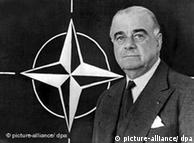
    In the words of its first Secretary General Lord Ismay, NATO was formed to “keep the Americans in, the Russians out and the Germans down.” Part one of DW-WORLD's NATO retrospective looks at the years 1949 to 1989.

    Washington, April 4, 1949. In a celebratory atmosphere, the foreign ministers of 12 North American and European countries signed the founding documents of the North Atlantic Treaty Organization, or NATO.

    Even if World War II was still fresh in the minds of those involved, NATO's biggest enemy wasn't demilitarized Germany, but the Soviet Union. For Western Europe, there was no alternative to this alliance with the United States, said former British Foreign Secretary Ernest Bevin in a radio broadcast.

    “What were peace- and freedom-loving nations to do?” he asked. “Stand by and wait for one after the other to be destroyed? Or build a system of collective security that would bind their people together in strong resistance against this threat? We decided in favor of this second way.”

    The NATO community

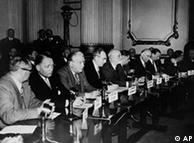
    Ministers sit at a meeting which marked the close of the North Atlantic Treaty Council conference in London's Lancaster House on May 18, 1950Bildunterschrift: Großansicht des Bildes mit der Bildunterschrift: NATO saw itself as a group with common values

    Central to the treaty is Article 5, which outlines the principle of collective defense. The article says that an attack on any member shall be considered to be an attack on all. How exactly the members contribute to the defense of the member under attack is left up to the discretion of the member states.

    From its inception, NATO saw itself as a community bound by common values. Despite this, non-democratic states were admitted to the fold, and not just for strategic reasons, according to the German military expert, Franz-Josef Meiers.

    “Inwardly, values play a very important role,” he said. “Membership was supposed to fast-track the democratization process in countries such as Spain or Greece.”

    Germany was a special case. Though it was destroyed in the war and demilitarized, it was nonetheless indispensable to NATO because of its long-term strategic value. On May 9, 1955, former German Chancellor Konrad Adenauer arrived in Paris to sign the membership declaration for his country. Hans Speidel, who would later serve as NATO commander during the Cold War before his death in 1984, was once asked to describe the moment.

    segunda-feira, 23 de março de 2009

    Polêmica interna marca retorno da França ao comando integrado da Otan

    Para os opositores, retorno da França às estruturas de comando da Otan rompe consenso de 43 anos e compromete originalidade política francesa. Governo em Paris considera ingresso uma chance de europeizar a aliança.

    Na polêmica envolvendo o retorno da França ao comando militar integrado da Otan, a Assembleia Nacional aprovou nesta terça-feira (17/03) moção de confiança ao governo do primeiro-ministro François Fillion. O governo obteve 329 votos a favor e 228 contra.

    Perante a Assembleia Nacional, nesta terça-feira (17/03), o primeiro-ministro francês, François Fillon, refutou as acusações de que a reintegração da França implicaria uma perda de autonomia. Ele também anunciou a intenção de se empenhar pela reforma da Otan, a fim de garantir maior influência do país sobre as decisões estratégicas da aliança.

    Em 1966, após ter se tornado uma potência atômica sob o presidente Charles de Gaulle, a França se afastou do comando integrado da Otan, a fim de se precaver do envolvimento em um eventual conflito nuclear durante a Guerra Fria. Hoje, o país participa de todas a operações militares e está representado em quase todos os grêmios da aliança.

    Quarenta e três anos após o desligamento, o presidente Nicolas Sarkozy pretende reinserir o país no comando militar integrado. Isso será formalizado durante a próxima cúpula da Otan, a ser realizada em Estrasburgo e Kehl/Baden-Baden, em 3 e 4 de abril.

    Do ponto de vista constitucional, a decisão não exigia aprovação do Parlamento. No entanto, como o retorno à Otan é uma medida polêmica dentro do próprio partido do governo, a União por um Movimento Popular (UMP), o primeiro-ministro submeteu-a ao voto de confiança.

    Por uma europeização da Otan

    O principal argumento do presidente Sarkozy é que os militares franceses já participam de inúmeras operações da aliança, sendo portanto inconcebível que o país não tenha influência sobre o planejamento das missões.

    O ministro francês do Exterior, Bernard Kouchner, refutou as críticas à medida, explicando que o afastamento da Otan ocorreu numa época em que havia tropas estrangeiras estacionadas na França e em que uma eventual guerra contra o bloco socialista inevitavelmente levaria a um confronto nuclear.

    Para o ministro francês da Defesa, Hervé Morin, a reintegração da França possibilitaria uma europeização da Otan: quanto mais responsabilidade os europeus assumirem, mais chances eles têm de influenciar a orientação da aliança.

    No entanto, Morin é contra uma "Otan global". O ingresso da Geórgia e da Ucrânia, favorecido por Washington, não poderá ocorrer sem a anuência da Rússia, advertiu o ministro francês. O premiê Fillon também reforçou essa posição: "A França e a Alemanha, sua parceira, acreditam na necessidade de respeitar a Rússia".

    Perda da "distância que permite dizer não"

    Para o líder da bancada socialista da Assembleia Nacional, Jean-Marc Ayrault, o retorno da França ao comando militar integrado da Otan rompe um consenso político de 43 anos. "Se reingressarmos", disse antes da votação, "mais uma vez serão os Estados Unidos a se manterem no comando das grandes questões militares e estratégicas". Para Ayrault, a França perderá a originalidade política que tinha até então: "Ainda nos lembramos da guerra no Iraque; na época, tínhamos razão, e isso nos trouxe muito prestígio".

    O antigo ministro da Defesa socialista Jean-Pierre Chevénement afirma que a reintegração tem "um alcance político e simbólico muito grande, mas não mudará muito a influência da França". "A Otan é uma organização amplamente dependente das orientações da diplomacia americana. Não temos peso nenhum e ainda perdemos a distância que permite dizer não", acrescentou ele.

    "Decisão corajosa"

    A chanceler federal alemã, Angela Merkel, já havia saudado a decisão de a França reingressar no comando militar integrado da Otan, após 43 anos de ausência. Merkel considera corajosa a atitude de Paris.

    O ministro alemão da Defesa, Franz-Josef Jung, acha a reintegração da França importante não só para a Otan, mas também para a Europa, "caso a União Européia continue se tornando uma estrutura sólida na política de defesa, a fim de poder atuar de forma eficiente em parceria com a aliança do Atlântico Norte".

    quinta-feira, 12 de março de 2009

    Sarkozy anuncia volta da França a comando militar da Otan

    A França está fora do comando desde 1966 e o presidente afirmou que 'independência não estará em questão'

    AP e Efe


    Sarkozy anuncia volta da França ao comando da Otan

    AP

    Sarkozy anuncia volta da França ao comando da Otan

    PARIS - O presidente da França, Nicolas Sarkozy, afirmou nesta quarta-feira que "chegou o momento" da reintegração plena da França à Organização do Tratado do Atlântico Norte (Otan) com seu retorno ao comando militar, como um passo necessário para enfrentar condições de segurança que mudaram "radicalmente". O país está fora desse comando desde 1966 e Sarkozy ressaltou que "a independência não estará em questão", em uma clara mensagem aos críticos segundo os quais o governo francês estaria abrindo mão de parte de sua soberania nacional em prol da aliança. O líder francês também ressaltou que o país manterá o controle sobre seu arsenal nuclear.

    O presidente Charles de Gaulle retirou a França do comando da Otan nos anos 1960, como forma de assegurar a soberania do país nos anos da Guerra Fria. Porém nesse período o país se manteve como membro da Otan.

    "A França não é mais ameaçada por uma invasão militar", as ameaças atuais são muito diferentes, segundo o chefe do Estado francês, que ressaltou que "uma nação solitária é uma nação que não tem nenhuma influência".

    Segundo Sarkozy, as novas ameaças exigem maior cooperação militar internacional. "Chegou a hora de por um fim a essa situação", afirmou ele em Paris, referindo-se ao fato de a França não fazer parte do comando militar da aliança.

    Sarkozy fez estas declarações no encerramento de um colóquio sobre a França, a defesa europeia e a Otan, com a participação, entre outras autoridades, do secretário-geral da Aliança, Jaap de Hoop Scheffer, e do alto representante para Política Externa e Segurança Comum da União Europeia (UE), Javier Solana.

    O presidente francês aproveitou a ocasião para explicar sua decisão de que França volte a participar plenamente do comando militar da Otan e para rebater as críticas de que isso implica em perda de soberania.

    Sarkozy disse que é justamente o afastamento da França da Otan que limita sua independência nacional.

    O porta-voz da Otan, James Appathurai, disse que a organização considera que o anúncio francês do retorno à estrutura militar integrada da organização beneficia a França, a Aliança e a União Europeia.

    É uma situação na qual "todos ganham", disse Appathurai, em declarações antes do anúncio feito pelo presidente francês.

    Para a França, significa o reconhecimento de sua "contribuição significativa" à Aliança, já que está entre os quatro países que oferecem mais meios e efetivos para as missões da organização, acrescentou o porta-voz.

    A decisão de Sarkozy de voltar à estrutura militar da Aliança deve se concretizar durante a cúpula que a Otan realizará no início de abril por ocasião dos 60 anos de sua criação, nas cidades de Estrasburgo (França) e Kehl (Alemanha).

    quinta-feira, 5 de fevereiro de 2009

    Cooperação entre UE e OTAN

    Paris, 4 fev (EFE).- O presidente francês, Nicolas Sarkozy, e a chanceler alemã, Angela Merkel, consideram hoje que a colaboração entre a União Europeia (UE) e a Organização do Tratado do Atlântico Norte (Otan) em matéria de defesa "não está à altura do esperado" e apostam em "uma autêntica cooperação fundada sobre a necessária complementaridade".

    "Em nossa opinião, o acordo estratégico entre Otan e UE não está à altura de nossas esperanças, devido aos desacordos persistentes entre certas nações. Pensamos que isso deve evoluir", afirmam os dois líderes em uma coluna conjunta publicada no site do jornal francês "Le Monde".

    O que chamam de "autêntica cooperação" entre UE e Otan em defesa é uma das prioridades que Sarkozy e Merkel estabelecem para a reforma da Aliança Atlântica por ocasião do 60º aniversário de sua criação.

    O texto dos líderes diz que França e Alemanha aguardam "um novo conceito estratégico" da Otan, que deve ter "novas orientações e ser transformada de forma crível".

    "Frente aos riscos do século XXI, é necessário reforçar a colaboração transatlântica de segurança e defesa e adaptá-la aos novos desafios", assinalam.

    Para isso, Sarkozy e Merkel acham que os Estados Unidos e a UE devem "analisar juntos as situações, tomar decisões comuns e colocá-las em andamento em colaboração", o que é "contraditório" com "decisões unilaterais".

    Os dois líderes consideram o programa nuclear iraniano "o maior desafio" da história do tratado de não-proliferação. Ambos se dizem determinados a impedir "o acesso do Irã ao armamento nuclear porque isso seria uma grave ameaça para a paz mundial".

    Segundo Sarkozy e Merkel, a chegada de Barack Obama à Casa Branca "está já marcada por novas ações em matéria de política externa e de segurança" e estão convencidos de que "a colaboração euro-atlântica em segurança permitirá que enfrentem juntos riscos e ameaças".

    "Trabalhando em um espírito de confiança, com vontade e coesão, construiremos, se não o melhor dos mundos, um mundo no qual progredirão a paz e a segurança para todos", concluíram

    domingo, 8 de junho de 2008

    NOVA BOY BAND - De soldados noruegueses no Kosovo

    Vale a pena dar uma conferida: (em inglês)


    E um vídeo mais sério sobre as tropas norueguesas no Afeganistão:


    http://www.youtube.com/watch?v=xCRkasbezk0&feature=related